Nonverbal Communication: AI Doesn't Understand
- Reni Siddall

- May 28, 2024
- 3 min read
There’s no computer learning system that can communicate like a human. The person’s mind and body are meant to communicate in ways artificial intelligence never will. Conveying information without using words, humans rely on unspoken communication and non-verbal messages to interpret the whole story, and AI doesn’t get it.
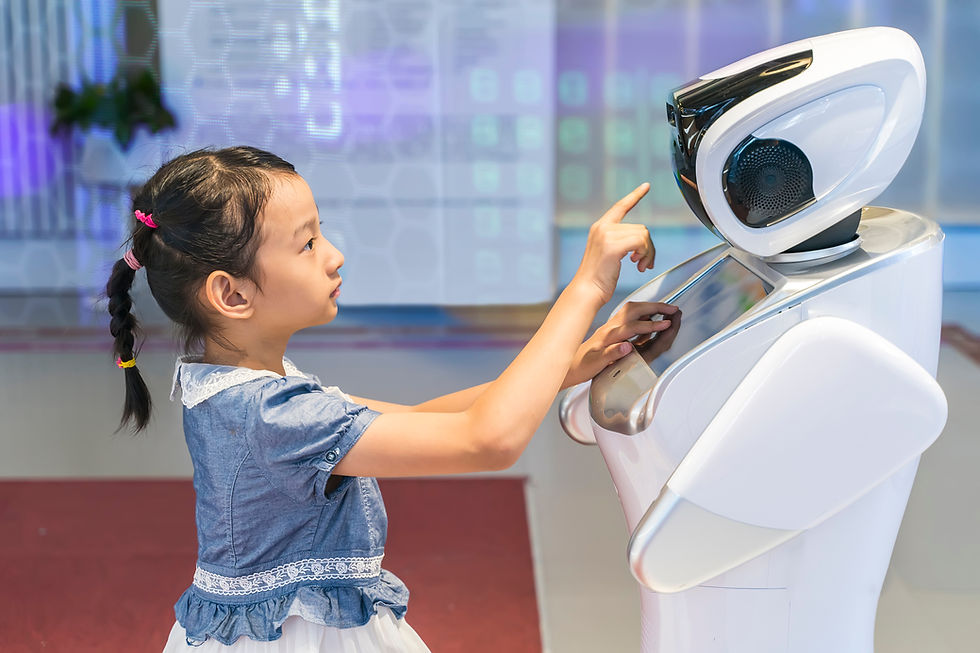
Nonverbal communication can trigger the sixth sense. The sixth sense lives in human consciousness, an innate impression that goes beyond our five commonly recognized senses – hearing, sight, taste, smell, and touch. When intuition kicks into gear and the feeling that something’s off or doesn’t jive, that’s the sixth sense. Will that ever be possible in our relations with artificial intelligence?
Beyond Reality, AI in the Movies
In Atlas, a recent 2024 Netflix sci-fi film starring Jennifer Lopez, the main character dissolves her trepidations about AI after being confronted with an “end-of-times” scenario. Her distrust of the computer learning system is derived from a childhood experience and is tested later in life. “Linked-up”, JLo and “Smith” can save the world. If JLo, allows the machine to access her mind, to sync her thoughts with the analytical AI, a superhuman can be born.
In a time of heightened skepticism toward the future of AI, the movie works hard to demonstrate that not all AI is bad. The anthropomorphized “Smith” barely gains JLo’s trust, and only does so to help prevent the “end-of-times”.

AI is depicted with even more human-like emotion in Spike Jonze’s 2013 romance/sci-fi movie Her, where the film follows the character Theodore Twombly (played by Joaquin Phoenix) as he develops a relationship with “Samantha” (played by Scarlett Johansson), an artificially intelligent virtual assistant.
Getting lost in the augmented reality of virtual love is not uncommon, but what’s missing is actual broad-spectrum, comprehensive communication. Communication derived from unspoken interaction brings with it a deep level of understanding, whether positive or negative.
"Human beings are not reasonable creatures. Instead of being ruled by logic, we are ruled by emotions. The world would be a happier place if the opposite were true." - Nicola Yoon, The Sun Is Also A Star
Integral to Connection: Unspoken Words
Experts have looked at non-verbal communication for decades, and studies show that up to 93 percent of communication is nonverbal. In 1970, the work of the University of California’s psychology professor, Albert Mehrabian, suggests that words account for only 7% of communication, while tone of voice represents 38% and facial expressions 55% of human interaction.
The disproportionate influence of nonverbal cues in conveying emotions and attitudes is evident through Mehrabian’s 7-38-55 rule, and sixth sense activation can stem from observing a combination of communication methods.
Forms of nonverbal communication include:
1. Tone of voice
2. Fidgeting
3. Facial expressions
4. Head or eye-movement
5. Hand gestures
6. Posture
7. Physical distance

Understanding is Key to Relationships
Increasing trust and credibility with the potential to add interest to your interactions, nonverbal communication plays an important role in how others perceive individuals. That gut feeling about someone comes from analyzing all forms of communication within an interaction.
Artificial intelligence does not have extrasensory perception; it can’t perceive awareness beyond what its programming can. Nor can it demonstrate nonverbal communication the way humans can. Without nonverbal communication, AI will not replace human connection. Intelligence does not equate to understanding; AI just doesn’t get it.


Comments